









Wer bekommt den Faust in die Hand?
Who Gets Their Hands on the Faust?
Frankfurter Allgemeine Zeitung
Samstag, 8. August 2026 · Nr. 182, Kunstmarkt, Seite 13
Andreas Platthaus · Frankfurt am Main
„Im Ganzen sprechen wir wohl vom bisher spektakulärsten Goethe-Buchangebot.“
“All in all, we are probably speaking of the most spectacular offering of Goethe books to date.”
- Goethe’s dissertation, 1771 $200,000
- Das Römische Carneval, 1789 $90,000
- The three Faust Volksbücher, 1589–1597 $195,000
- Werther, first printing, 1774 $69,000
- Werther, second printing, 1774 $12,000
- Faust: Ein Fragment, 1790 $36,000
- Faust I, 1808 $21,000
- Faust II, 1833 $24,000
- Die Wahlverwandtschaften, 1809 $5,800
- Wilhelm Meisters Wanderjahre, 1821 $5,000
- Zur Farbenlehre, 1810 $45,000
- Auserlesene Lieder, Doves Press, 1916 $65,000
- Urfaust, Bremer Presse, 1920 $3,000
Prices shown are current. Figures quoted in the article are those printed on 8 August 2026.
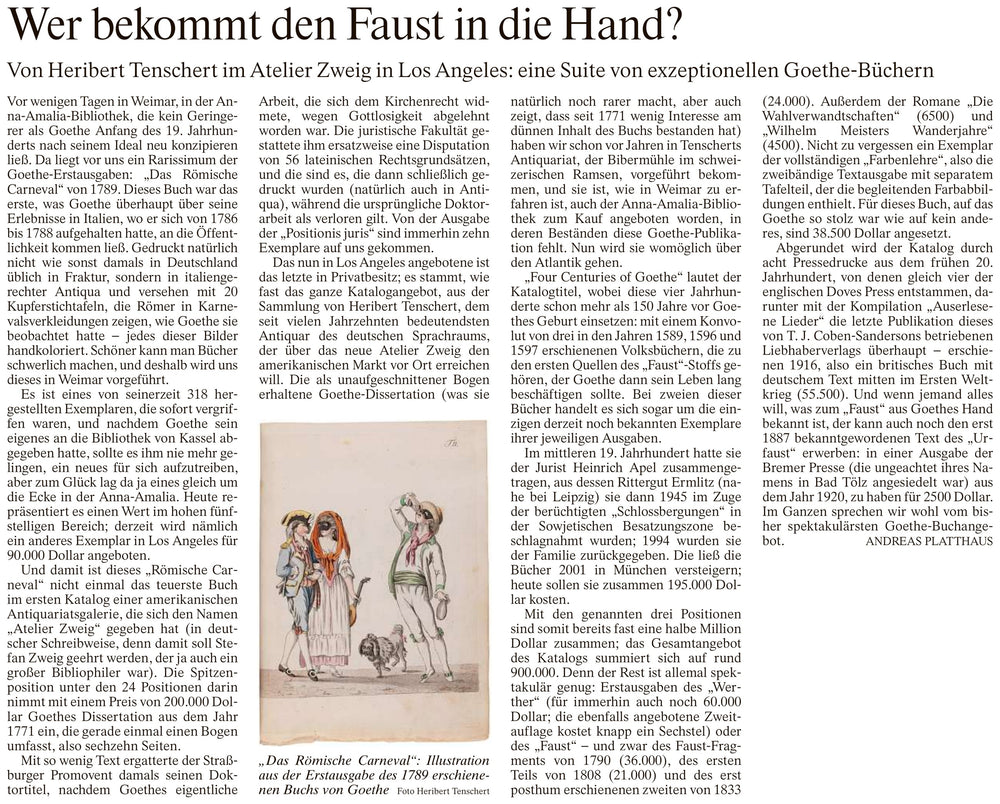
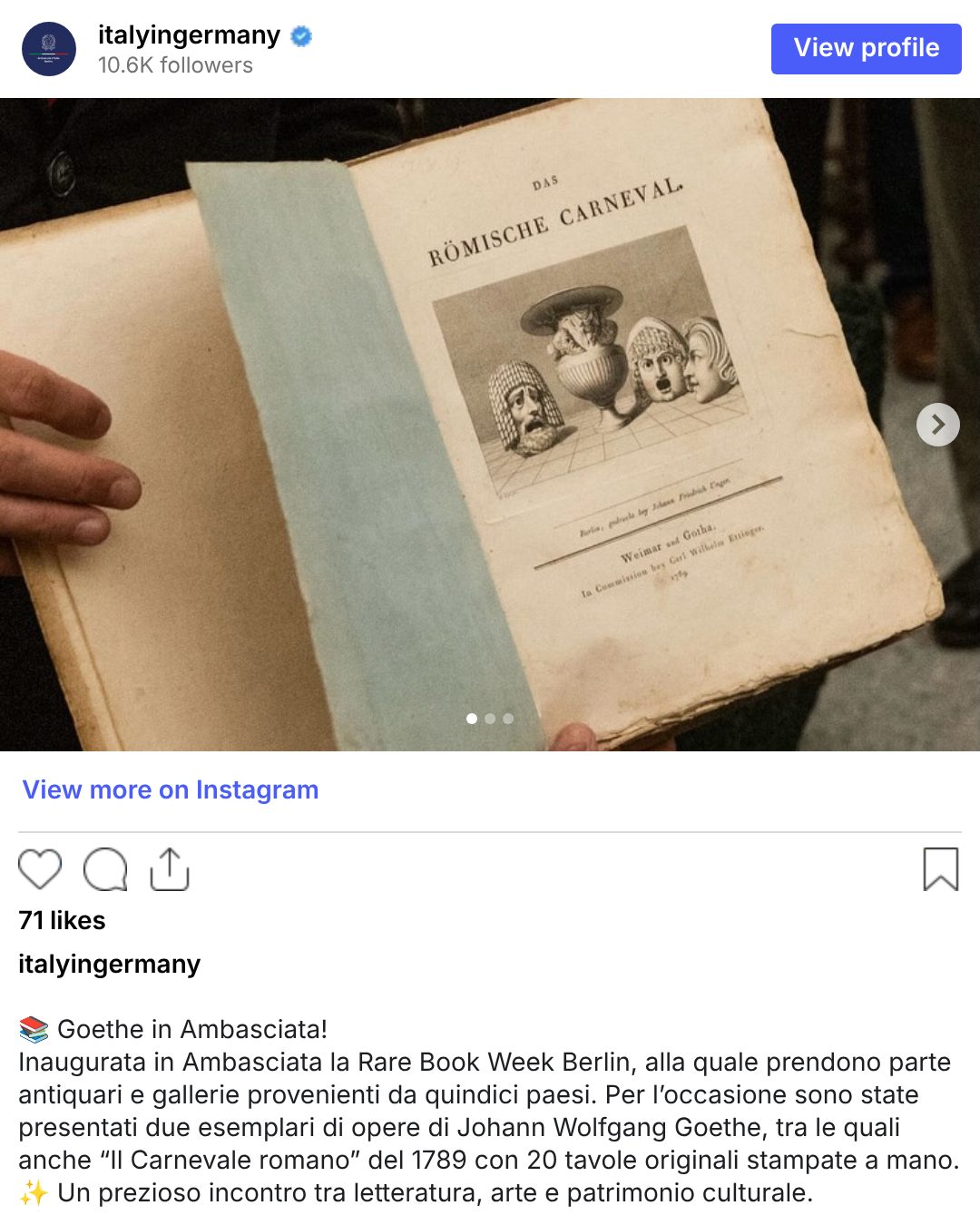
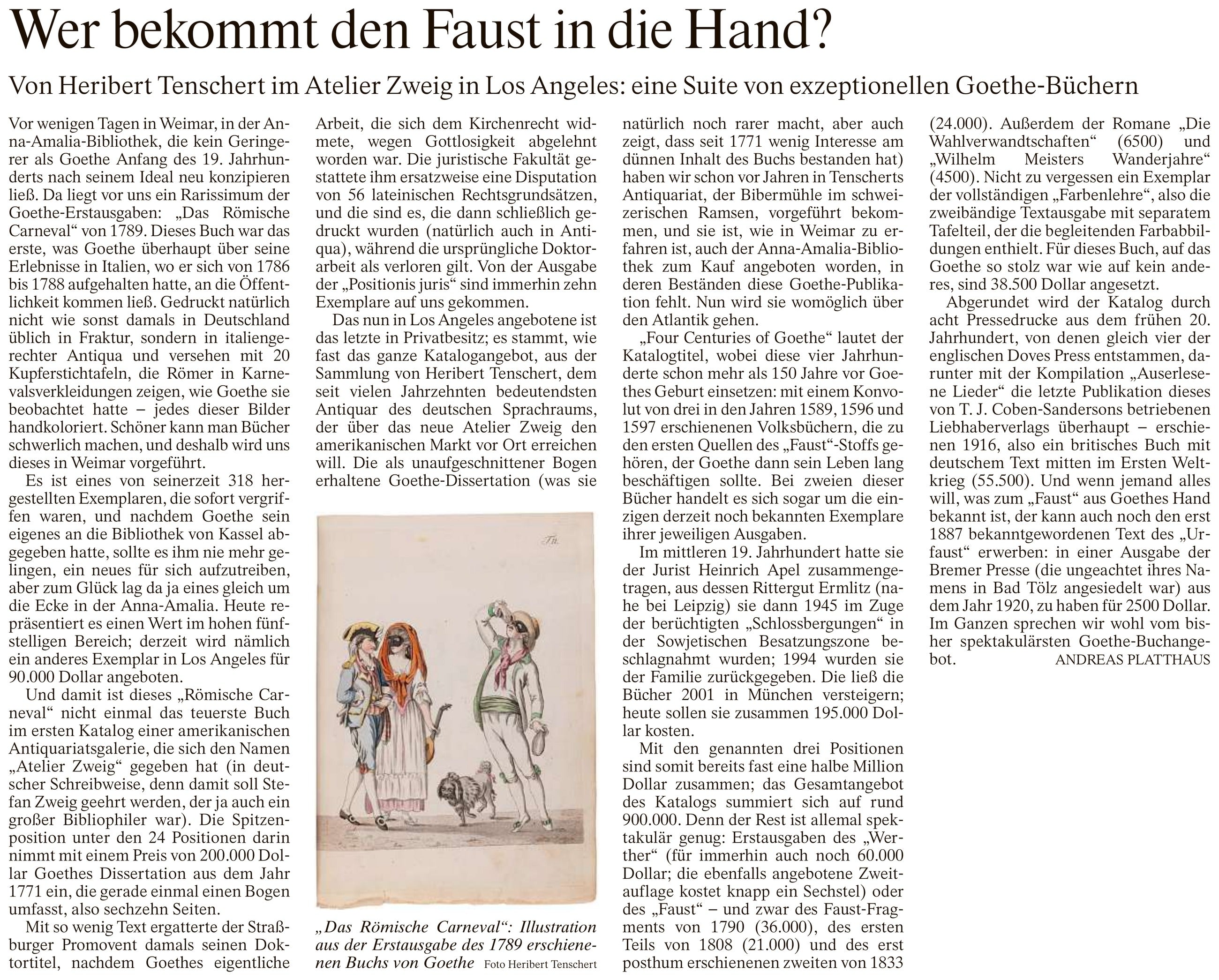
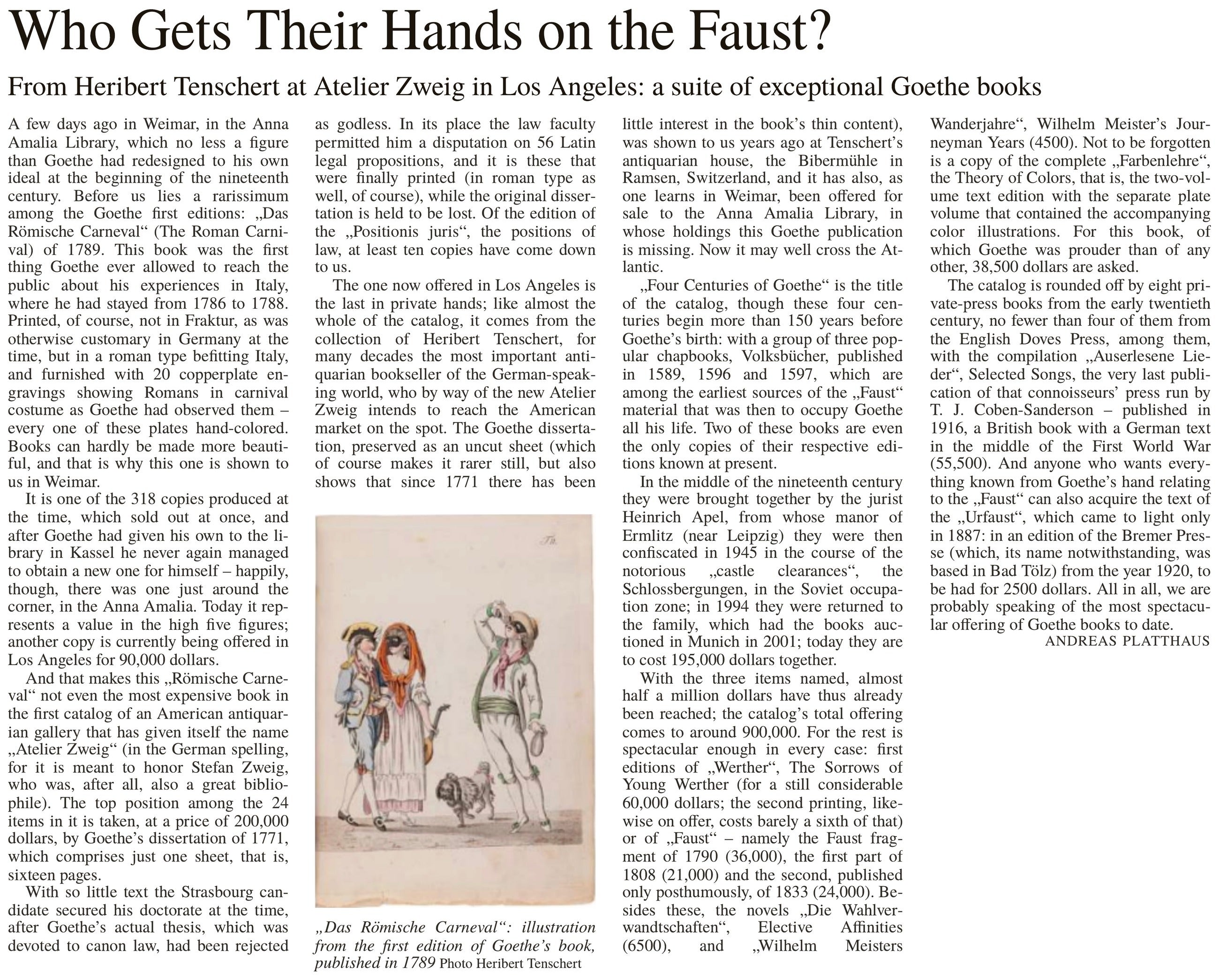
Vor wenigen Tagen in Weimar, in der Anna-Amalia-Bibliothek, die kein Geringerer als Goethe Anfang des 19. Jahrhunderts nach seinem Ideal neu konzipieren ließ. Da liegt vor uns ein Rarissimum der Goethe-Erstausgaben: „Das Römische Carneval“ von 1789. Dieses Buch war das erste, was Goethe überhaupt über seine Erlebnisse in Italien, wo er sich von 1786 bis 1788 aufgehalten hatte, an die Öffentlichkeit kommen ließ. Gedruckt natürlich nicht wie sonst damals in Deutschland üblich in Fraktur, sondern in italiengerechter Antiqua und versehen mit 20 Kupferstichtafeln, die Römer in Karnevalsverkleidungen zeigen, wie Goethe sie beobachtet hatte – jedes dieser Bilder handkoloriert. Schöner kann man Bücher schwerlich machen, und deshalb wird uns dieses in Weimar vorgeführt.
Es ist eines von seinerzeit 318 hergestellten Exemplaren, die sofort vergriffen waren, und nachdem Goethe sein eigenes an die Bibliothek von Kassel abgegeben hatte, sollte es ihm nie mehr gelingen, ein neues für sich aufzutreiben, aber zum Glück lag da ja eines gleich um die Ecke in der Anna-Amalia. Heute repräsentiert es einen Wert im hohen fünfstelligen Bereich; derzeit wird nämlich ein anderes Exemplar in Los Angeles für 90.000 Dollar angeboten.
Und damit ist dieses „Römische Carneval“ nicht einmal das teuerste Buch im ersten Katalog einer amerikanischen Antiquariatsgalerie, die sich den Namen „Atelier Zweig“ gegeben hat (in deutscher Schreibweise, denn damit soll Stefan Zweig geehrt werden, der ja auch ein großer Bibliophiler war). Die Spitzenposition unter den 24 Positionen darin nimmt mit einem Preis von 200.000 Dollar Goethes Dissertation aus dem Jahr 1771 ein, die gerade einmal einen Bogen umfasst, also sechzehn Seiten.
Mit so wenig Text ergatterte der Straßburger Promovent damals seinen Doktortitel, nachdem Goethes eigentliche Arbeit, die sich dem Kirchenrecht widmete, wegen Gottlosigkeit abgelehnt worden war. Die juristische Fakultät gestattete ihm ersatzweise eine Disputation von 56 lateinischen Rechtsgrundsätzen, und die sind es, die dann schließlich gedruckt wurden (natürlich auch in Antiqua), während die ursprüngliche Doktorarbeit als verloren gilt. Von der Ausgabe der „Positionis juris“ sind immerhin zehn Exemplare auf uns gekommen.
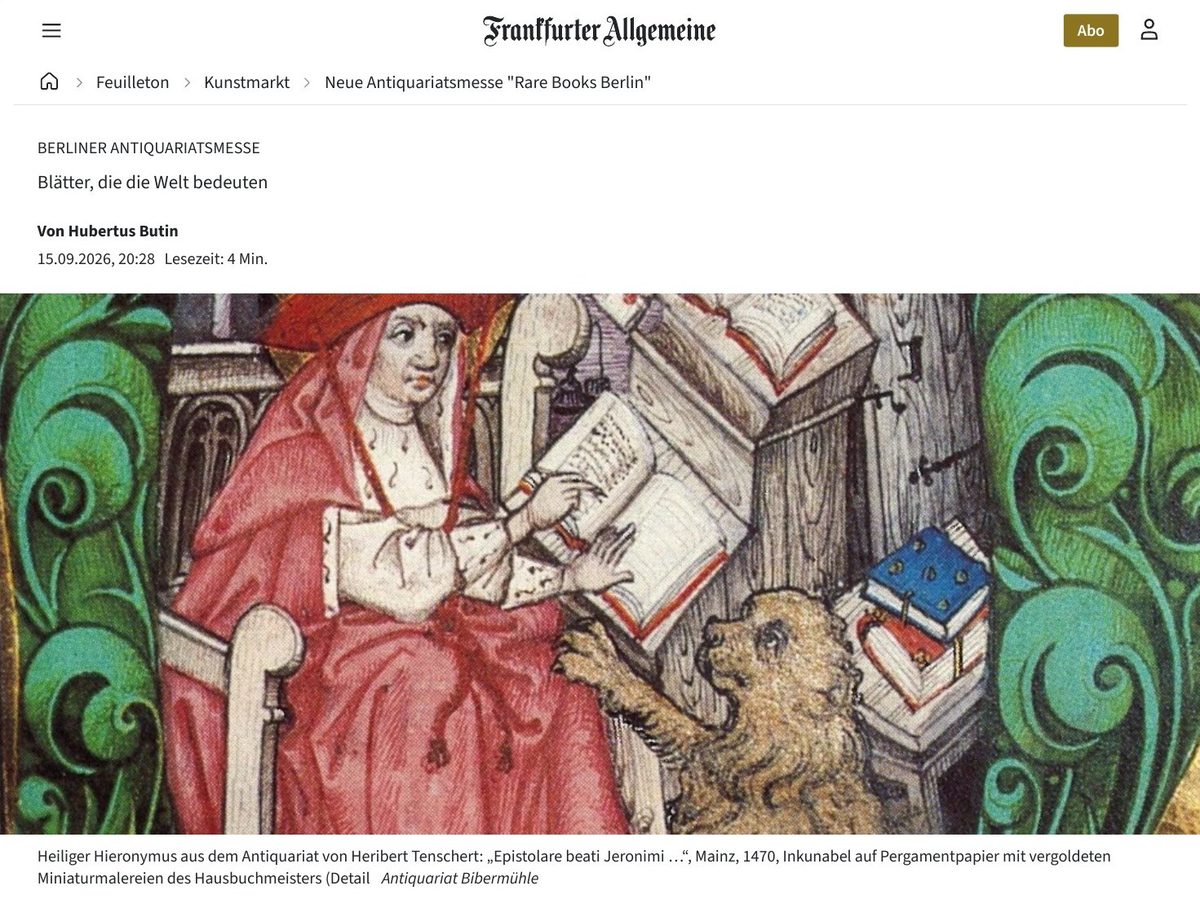
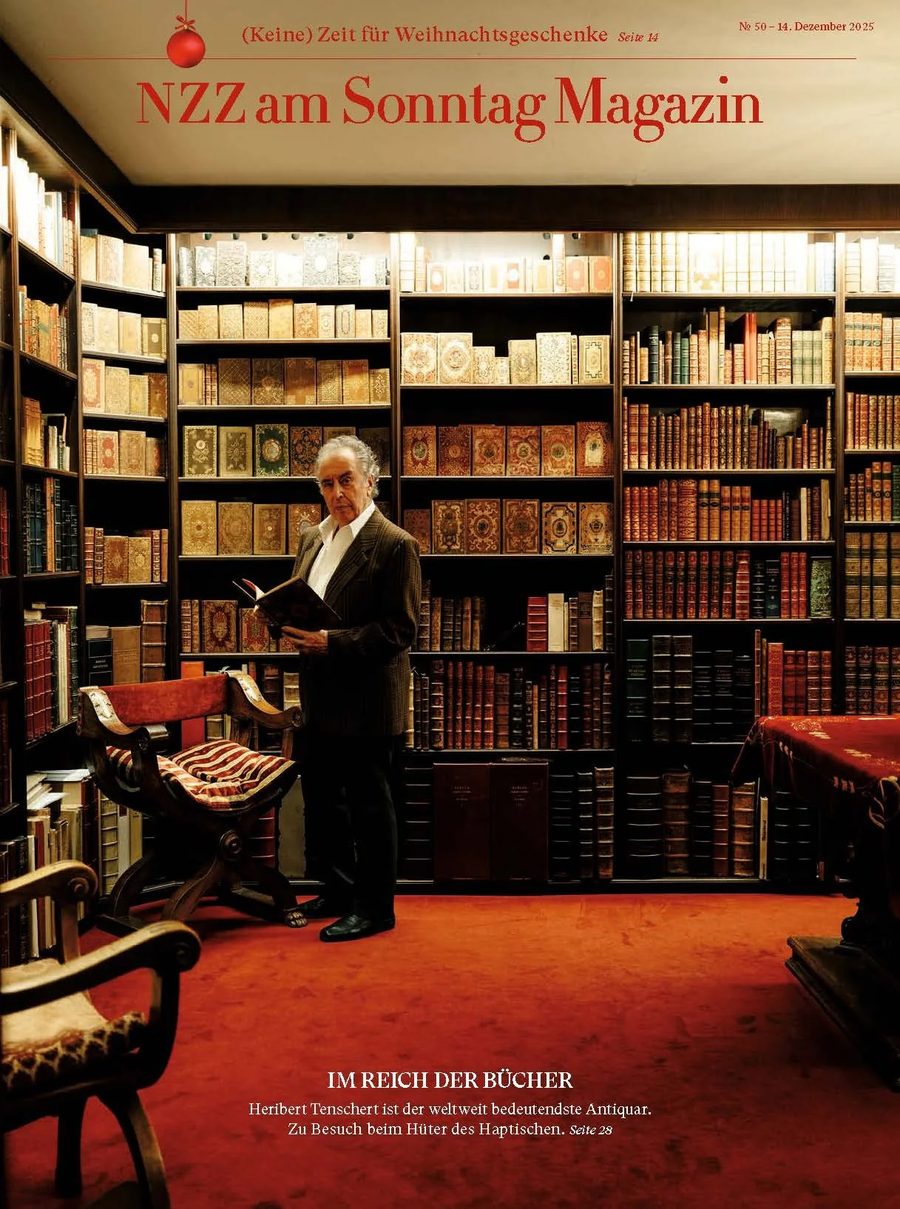
Das nun in Los Angeles angebotene ist das letzte in Privatbesitz; es stammt, wie fast das ganze Katalogangebot, aus der Sammlung von Heribert Tenschert, dem seit vielen Jahrzehnten bedeutendsten Antiquar des deutschen Sprachraums, der über das neue Atelier Zweig den amerikanischen Markt vor Ort erreichen will. Die als unaufgeschnittener Bogen erhaltene Goethe-Dissertation (was sie natürlich noch rarer macht, aber auch zeigt, dass seit 1771 wenig Interesse am dünnen Inhalt des Buchs bestanden hat) haben wir schon vor Jahren in Tenscherts Antiquariat, der Bibermühle im schweizerischen Ramsen, vorgeführt bekommen, und sie ist, wie in Weimar zu erfahren ist, auch der Anna-Amalia-Bibliothek zum Kauf angeboten worden, in deren Beständen diese Goethe-Publikation fehlt. Nun wird sie womöglich über den Atlantik gehen.
„Four Centuries of Goethe“ lautet der Katalogtitel, wobei diese vier Jahrhunderte schon mehr als 150 Jahre vor Goethes Geburt einsetzen: mit einem Konvolut von drei in den Jahren 1589, 1596 und 1597 erschienenen Volksbüchern, die zu den ersten Quellen des „Faust“-Stoffs gehören, der Goethe dann sein Leben lang beschäftigen sollte. Bei zweien dieser Bücher handelt es sich sogar um die einzigen derzeit noch bekannten Exemplare ihrer jeweiligen Ausgaben.
Im mittleren 19. Jahrhundert hatte sie der Jurist Heinrich Apel zusammengetragen, aus dessen Rittergut Ermlitz (nahe bei Leipzig) sie dann 1945 im Zuge der berüchtigten „Schlossbergungen“ in der Sowjetischen Besatzungszone beschlagnahmt wurden; 1994 wurden sie der Familie zurückgegeben. Die ließ die Bücher 2001 in München versteigern; heute sollen sie zusammen 195.000 Dollar kosten.
Mit den genannten drei Positionen sind somit bereits fast eine halbe Million Dollar zusammen; das Gesamtangebot des Katalogs summiert sich auf rund 900.000. Denn der Rest ist allemal spektakulär genug: Erstausgaben des „Werther“ (für immerhin auch noch 60.000 Dollar; die ebenfalls angebotene Zweitauflage kostet knapp ein Sechstel) oder des „Faust“ – und zwar des Faust-Fragments von 1790 (36.000), des ersten Teils von 1808 (21.000) und des erst posthum erschienenen zweiten von 1833 (24.000). Außerdem der Romane „Die Wahlverwandtschaften“ (6500) und „Wilhelm Meisters Wanderjahre“ (4500). Nicht zu vergessen ein Exemplar der vollständigen „Farbenlehre“, also die zweibändige Textausgabe mit separatem Tafelteil, der die begleitenden Farbabbildungen enthielt. Für dieses Buch, auf das Goethe so stolz war wie auf kein anderes, sind 38.500 Dollar angesetzt.
Abgerundet wird der Katalog durch acht Pressedrucke aus dem frühen 20. Jahrhundert, von denen gleich vier der englischen Doves Press entstammen, darunter mit der Kompilation „Auserlesene Lieder“ die letzte Publikation dieses von T. J. Coben-Sandersons betriebenen Liebhaberverlags überhaupt – erschienen 1916, also ein britisches Buch mit deutschem Text mitten im Ersten Weltkrieg (55.500). Und wenn jemand alles will, was zum „Faust“ aus Goethes Hand bekannt ist, der kann auch noch den erst 1887 bekanntgewordenen Text des „Urfaust“ erwerben: in einer Ausgabe der Bremer Presse (die ungeachtet ihres Namens in Bad Tölz angesiedelt war) aus dem Jahr 1920, zu haben für 2500 Dollar. Im Ganzen sprechen wir wohl vom bisher spektakulärsten Goethe-Buchangebot.
Bildunterschrift im Original: „Das Römische Carneval“: Illustration aus der Erstausgabe des 1789 erschienenen Buchs von Goethe. Foto: Heribert Tenschert
A few days ago in Weimar, in the Anna Amalia Library, which no less a figure than Goethe had redesigned to his own ideal at the beginning of the nineteenth century. Before us lies a rarissimum among the Goethe first editions: Das Römische Carneval (The Roman Carnival) of 1789. This book was the first thing Goethe ever allowed to reach the public about his experiences in Italy, where he had stayed from 1786 to 1788. Printed, of course, not in Fraktur, as was otherwise customary in Germany at the time, but in a roman type befitting Italy, and furnished with 20 copperplate engravings showing Romans in carnival costume as Goethe had observed them – every one of these plates hand-colored. Books can hardly be made more beautiful, and that is why this one is shown to us in Weimar.
It is one of the 318 copies produced at the time, which sold out at once, and after Goethe had given his own to the library in Kassel he never again managed to obtain a new one for himself – happily, though, there was one just around the corner, in the Anna Amalia. Today it represents a value in the high five figures; another copy is currently being offered in Los Angeles for 90,000 dollars.
And that makes this Römische Carneval not even the most expensive book in the first catalog of an American antiquarian gallery that has given itself the name „Atelier Zweig“ (in the German spelling, for it is meant to honor Stefan Zweig, who was, after all, also a great bibliophile). The top position among the 24 items in it is taken, at a price of 200,000 dollars, by Goethe’s dissertation of 1771, which comprises just one sheet, that is, sixteen pages.
With so little text the Strasbourg candidate secured his doctorate at the time, after Goethe’s actual thesis, which was devoted to canon law, had been rejected as godless. In its place the law faculty permitted him a disputation on 56 Latin legal propositions, and it is these that were finally printed (in roman type as well, of course), while the original dissertation is held to be lost. Of the edition of the Positionis juris, the positions of law, at least ten copies have come down to us.
The one now offered in Los Angeles is the last in private hands; like almost the whole of the catalog, it comes from the collection of Heribert Tenschert, for many decades the most important antiquarian bookseller of the German-speaking world, who by way of the new Atelier Zweig intends to reach the American market on the spot. The Goethe dissertation, preserved as an uncut sheet (which of course makes it rarer still, but also shows that since 1771 there has been little interest in the book’s thin content), was shown to us years ago at Tenschert’s antiquarian house, the Bibermühle in Ramsen, Switzerland, and it has also, as one learns in Weimar, been offered for sale to the Anna Amalia Library, in whose holdings this Goethe publication is missing. Now it may well cross the Atlantic.
„Four Centuries of Goethe“ is the title of the catalog, though these four centuries begin more than 150 years before Goethe’s birth: with a group of three popular chapbooks, Volksbücher, published in 1589, 1596 and 1597, which are among the earliest sources of the „Faust“ material that was then to occupy Goethe all his life. Two of these books are even the only copies of their respective editions known at present.
In the middle of the nineteenth century they were brought together by the jurist Heinrich Apel, from whose manor of Ermlitz (near Leipzig) they were then confiscated in 1945 in the course of the notorious „castle clearances“, the Schlossbergungen, in the Soviet occupation zone; in 1994 they were returned to the family, which had the books auctioned in Munich in 2001; today they are to cost 195,000 dollars together.
With the three items named, almost half a million dollars have thus already been reached; the catalog’s total offering comes to around 900,000. For the rest is spectacular enough in every case: first editions of „Werther“, The Sorrows of Young Werther (for a still considerable 60,000 dollars; the second printing, likewise on offer, costs barely a sixth of that) or of „Faust“ – namely the Faust fragment of 1790 (36,000), the first part of 1808 (21,000) and the second, published only posthumously, of 1833 (24,000). Besides these, the novels „Die Wahlverwandtschaften“, Elective Affinities (6500), and „Wilhelm Meisters Wanderjahre“, Wilhelm Meister’s Journeyman Years (4500). Not to be forgotten is a copy of the complete „Farbenlehre“, the Theory of Colors, that is, the two-volume text edition with the separate plate volume that contained the accompanying color illustrations. For this book, of which Goethe was prouder than of any other, 38,500 dollars are asked.
The catalog is rounded off by eight private-press books from the early twentieth century, no fewer than four of them from the English Doves Press, among them, with the compilation „Auserlesene Lieder“, Selected Songs, the very last publication of that connoisseurs’ press run by T. J. Coben-Sanderson – published in 1916, a British book with a German text in the middle of the First World War (55,500). And anyone who wants everything known from Goethe’s hand relating to the „Faust“ can also acquire the text of the „Urfaust“, which came to light only in 1887: in an edition of the Bremer Presse (which, its name notwithstanding, was based in Bad Tölz) from the year 1920, to be had for 2500 dollars. All in all, we are probably speaking of the most spectacular offering of Goethe books to date.
Caption as printed: „Das Römische Carneval“: illustration from the first edition of Goethe’s book, published in 1789. Photo: Heribert Tenschert
Andreas Platthaus, Wer bekommt den Faust in die Hand? Frankfurter Allgemeine Zeitung, Nr. 182, Kunstmarkt, Seite 13, 8 August 2026. (c) Frankfurter Allgemeine Zeitung GmbH, Frankfurt am Main. All rights reserved.

